

Synopsis
“Red Tails” preproduction started in January 2009, after scouting locations around Europe and the USA, and it was filmed during 2009 in the Czech Republic and Croatia. The film, directed by Anthony Hemingway and produced by George Lucas from Lucasfilm with Fox, follows the “Tuskegee Airmen”, brave African American pilots of P-51 Mustangs, who fight against the Nazis, but also the racism in aviation. It was premiered in 2012 after filming additional shots and changes in direction for justified production reasons. The film was produced by George Lucas as a part of his production company Lucasfilm. Nine days before the American premiere, the film was aired in the White House with the presence of the President Barack Obama and the surviving pilots.
details
Original title: Red Tails
Also known as: Crveni repovi
Year: 2012
Country of production: USA
Production: Twentieth Century Fox, LucasFilm, Pakt Media, Partnership Pictures
Genre: drama, adventure, war
Directed by: Anthony Hemingway
Starring: Cuba Gooding Jr., Gerald McRaney, David Oyelowo, Nate Parker, Gerald McRaney, Terrence Howard, Michael B. Jordan
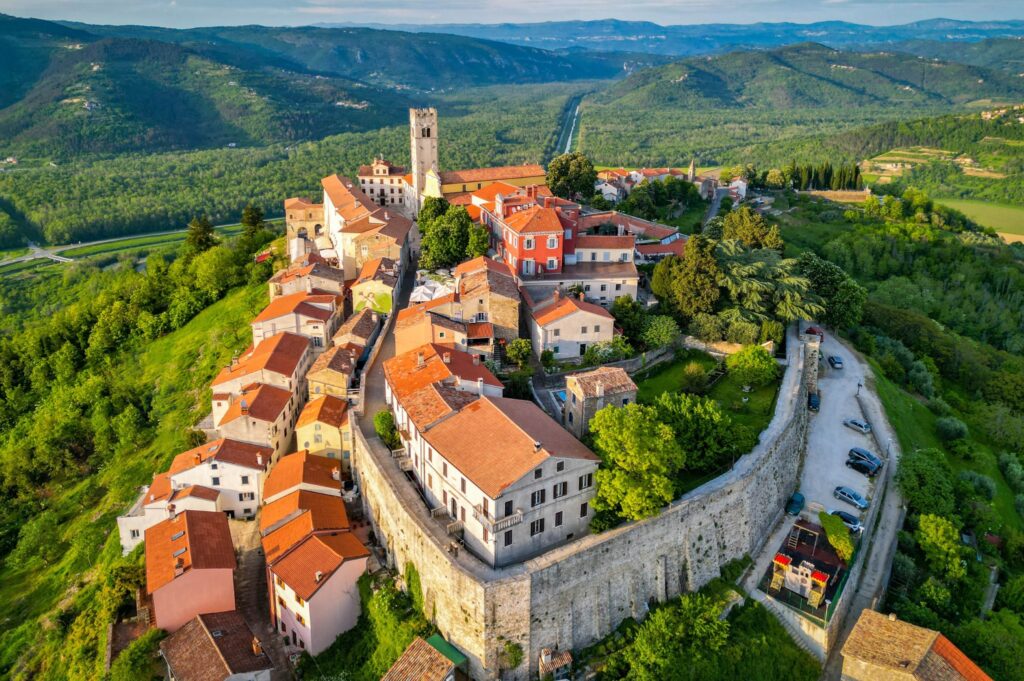
Filming locations in Istria: Draguć, Grožnjan, Motovun, Rovinj
Other locations: Prague, Italy Hamilton Air Force Base, Novato, California, Lucasfilm Studios - Skywalker Ranch, San Rafael, California, Shreveport, Louisiana
REVIEW
RED TAILS, directed by Anthony Hemingway, 2012
THE SKY HEROES THAT HOLLYWOOD ALMOST DIDN’T WANT
“Patriotic, chauvinistic, old-fashioned, corny and inspiring for teenagers” – that's how George Lucas, one of the executive producers, described “Red Tails” in a guest appearance on the late-night satirical show The Daily Show with Jon Stewart. Lucas made the film about African-American pilots from World War II at his own expense, because Hollywood studios did not want to finance an action spectacle with a predominantly black cast.
The Tuskegee Airmen, also known as the “Red Tails”, were the first group of African-American fighter pilots in the history of the US Air Force. Despite systemic racism and intolerance within the military during World War II, they proved to be extremely successful: they protected bombers, shot down enemy aircraft (including the revolutionary Messerschmitt Me 262), and earned the respect of even white pilots, who initially despised them.
At a time when “studies” claimed that blacks “lacked the capacity to operate complex machines”, the Red Tails ” literally and symbolically turned the tide. Their success refuted the infamous racist “study” by the U.S. War College in 1925, which claimed that blacks lacked intelligence, courage, and fighting ability. They protected American bombers so well that pilots deliberately sought them out as escorts. One of the lines in which they tried to position themselves in front of their superiors, with extreme respect for authority and military hierarchy, so that they and their engagements were not viewed only through prejudice, is:
If "arrogance" is the only word people use to describe me now, I would say I am progressing.
The plot focuses on the relationships within the 332nd Squadron, based in Italy. Joe “Lightning” Little is an impulsive, charismatic pilot who often breaks the rules, while his commander Marty “Easy” Julian is steady, prone to self-reproach and seeks solace in alcohol. Their relationship forms the emotional core of the film. The dialogues are often stiff, and the emotional relationships of the characters are simple, with a carefully arranged, parallel narrative thread about Lightning’s love story, whose fate, partly due to chance, partly due to his fighting character who never rests, is tragic. But, to be honest, war films of that era were not much deeper. Instead of a drama about racial injustice, this personal project of Lucas is a war genre film, focused on air combat and the visual impression that he has been preparing for almost 25 years.
The majority of the film consists of tense sequences of chasing enemy aircraft, shot from the first person, with a minimum of dialogue and classic “motivational speeches”. The film excels in the scenes of air battles, and all of this is extremely well-edited. The CGI may not be entirely aesthetically convincing, but it does provide an adrenaline rush with explosions, fast maneuvers, looping and takeoffs. Anyone who loves war chronicles will find something aesthetically familiar they like. Lucas, known for his obsession with aerial combat, admits that classics like “Wings” (1927) served as an inspiration for “Star Wars”.
The cast is impressive, with Terrence Howard and Cuba Gooding Jr., who also starred in the earlier HBO version, filmed in 1995. The character of General Luntz, one of the few white characters in the film, is fictional and symbolizes resistance within the military structures. The narrative touches on deep-rooted racism in American society in a solid and gradual way: from exclusion from the officers' club to open insults and institutional discrimination.
The dramatic content is subordinate to the visual part, and in this context, it can be said that the film lacks the fullness of dramatic charge and that the intention was to replace it with an exceptionally polished image. Such a beautiful image for a war film can represent the (too) strong enthusiasm of the warrior, something that is difficult to connect, at least from a broader context, with the life goals of many young people today. However, overall, in the subtext, but also in the structure of the main narrative thread, the context of Jim Crow is missing - the system in which these pilots grew up, because their success was more than a military victory - it was an act of defiance and dignity in a country that did not recognize them as equals.
The film is technically impressive, action-packed, and has a soul, but you do not feel the real weight of war, the fear in the eyes of the pilots who could have died on every mission, although it is visible in many details, but also in the broader picture. There is not enough reflection, dilemmas, inner turmoil, anything that would show them as whole people, and not just heroes in the cockpit. There is a lack of strong characters and their true relationship with each other, while the ending is sweet and safe, more in the tone of a school baseball victory than war catharsis. In that sense, the narrative is more palatable for viewers, but the characters' courage is reduced to sentiment, while it is still in a much deeper context. “Red Tails” offers a valuable story about perseverance, talent, equality and the right to recognition, and Lucas's effort to make the film happen is a strong political commentary. But when everything is added up, the question remains – could this have been a film with greater depth?